
The past year has brought major changes across the federal workforce. Learn how the recent downsizing of federal agencies has impacted the retirement process and employee morale.
Many employees have faced difficult decisions about whether to stay in government service or take one of the recent “fork in the road” offers. This article explores how many people actually left, how these numbers compare to normal retirement patterns, and how morale has shifted across agencies. Let’s look at the real impact of these departures and some proactive steps to take regarding your federal benefits.
The “Fork in the Road”: How Many Employees Chose to Leave?
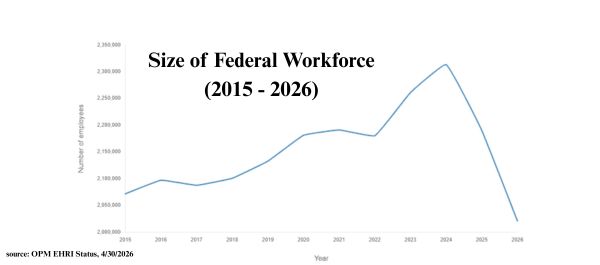
In 2025, and continuing into 2026, federal agencies have offered a wide range of early‑out incentives and separation options. The one that garnered the most attention from the public occurred at the onset of the current administration and the creation of DOGE. Sent to a majority of federal employees at all stages in their career, the “fork in the road” email offered months of pay in exchange for their resignation. Also known as the deferred resignation program (DRP), roughly 137,000 – 154,000 federal employees accepted either the initial offer or another DRP opportunity in 2025. Outside of voluntary offers to leave service, estimates show that last year, another 10,400 employees were separated through a Reduction in Force (RIF), which is an involuntary process where positions are eliminated.
Some agencies experienced especially dramatic shifts. The Department of Defense, for example, reduced its civilian workforce by more than 78,000 employees, which was roughly 10% of the agency’s total staff, in a single year. Much of this reduction came through the DRP, which allowed agencies to downsize quickly while giving employees a structured path out. However, those who chose not to leave service over the past two years are experiencing degrading morale due to staff shortages, massive workloads, and new policies impacting agency operations.
These numbers represent one of the largest single‑year workforce contractions in recent federal history. The last big upheaval of federal jobs came during the Clinton administration when over 400,000 jobs were cut between 1994 and 1999. Most of those positions were blue collar jobs that were outsourced to federal contractors.
How Recent Departures Compare to Normal Retirement Trends
At first glance, the number of employees who accepted separation offers doesn’t match the official retirement statistics. In 2025, the Office of Personnel Management processed 112,679 retirement claims, significantly fewer than the total number of people who left federal service.
This gap exists because not everyone who accepted an offer was eligible for an immediate pension. Many younger employees, or those with shorter service histories, chose to take a refund of their retirement contributions rather than wait for a deferred pension years down the road. Others separated but won’t collect their pension until they’ve reached the required age.
Even with this discrepancy, retirement activity was still unusually high. The 2025 claim volume was about 8% higher than the recent six‑year average and 17% higher than the broader 25‑year average. And the trend is continuing into 2026. OPM processed 15,571 claims in January 2026 and 17,175 in April, roughly double the typical historical volume for those months.
Impact on Federal Employee Morale
With so many changes happening at once, it’s no surprise that many federal employees have felt the strain. A 2025 Gallup survey found that morale across the federal workforce dropped sharply as downsizing and civil service reforms took effect. Compared to state and local government workers, federal employees reported a steeper decline in job satisfaction and engagement, along with higher levels of burnout.
During the second quarter of 2025, federal employees were 15 points less likely to report high job satisfaction and roughly 8 to 9 points more likely to report high burnout than their state and local counterparts. They were also about 8 points more likely to be actively searching for a new job.
But there is encouraging news. By the end of 2025 and into the first quarter of 2026, these morale indicators began to rebound. Job‑search activity returned to levels similar to state and local workers, and satisfaction metrics stabilized. While the federal workforce is still adjusting to a new normal, the data suggests that employees are regaining their footing. It could also be a sign that many people who were dissatisfied last years have since found another job outside of the federal government.
Next Steps for Federal Employees
If you haven’t started to seriously plan your exit already, now is the time to take a clear look at your retirement benefits and eligibility. Knowing you’re on the right track to retirement from the federal government is key. Start by reviewing your age and service requirements, especially your Minimum Retirement Age (MRA), so you understand exactly when you qualify for different retirement options. If you receive a buyout or early‑out offer, take time to weigh the immediate financial incentives against the long‑term impact on your pension, Social Security timing, and overall retirement security.
It’s also important to review your insurance coverage. Continuing your Federal Employees Health Benefits (FEHB) plan and Federal Employee Group Life Insurance (FEGLI) coverage into retirement generally requires that you’ve been enrolled for the five years immediately before you retire. Many employees overlook this rule until it’s too late.
And finally, don’t hesitate to reach out for help. With the new online retirement application (ORA), the need for an error-free application is more crucial than ever. Just because the process has moved to a digital one, it is not as automated as some feds assume. Before going to OPM, the application must first be reviewed by your agency’s HR department, then submitted to the company that handles your agency’s payroll, and if no errors were spotted at this point, sent to OPM for final approval. Even one error during the initial application submission can cause significant delays in receiving your pension.
A trusted benefits specialist can help you understand your options, avoid costly mistakes, and build a plan that supports your long‑term financial goals.
Fill out the form below to get started: